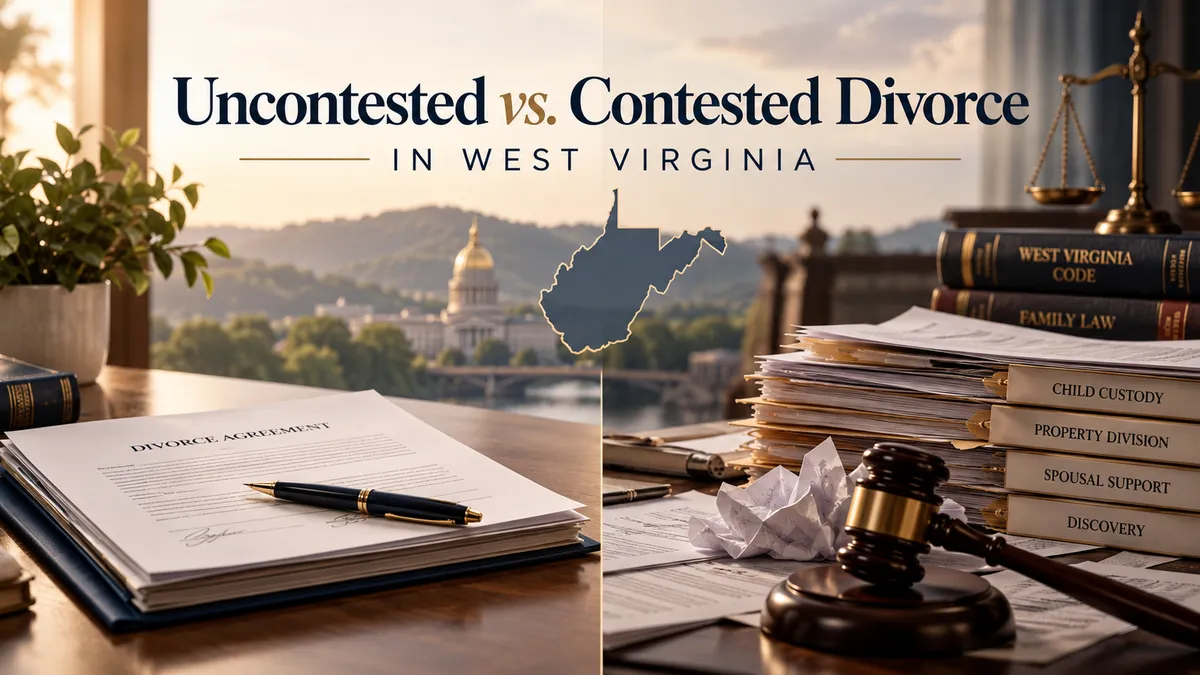
Uncontested vs. Contested Divorce in West Virginia
Uncontested vs. Contested Divorce in West Virginia
Two divorces can end the same way on paper and feel completely different along the way. The biggest difference usually isn't the reason for the divorce. It's whether you and your spouse agree on how to divide your lives. When you file for divorce in West Virginia, that one question decides whether your case is uncontested or contested, and it shapes how much time, money and stress the divorce process takes. This guide explains what each term means, what you have to agree on, and what happens when you agree on some things but not others.
This article is general information, not legal advice. Every case depends on its own facts, so speak with a family law attorney about your situation.
What Is an Uncontested Divorce in West Virginia?
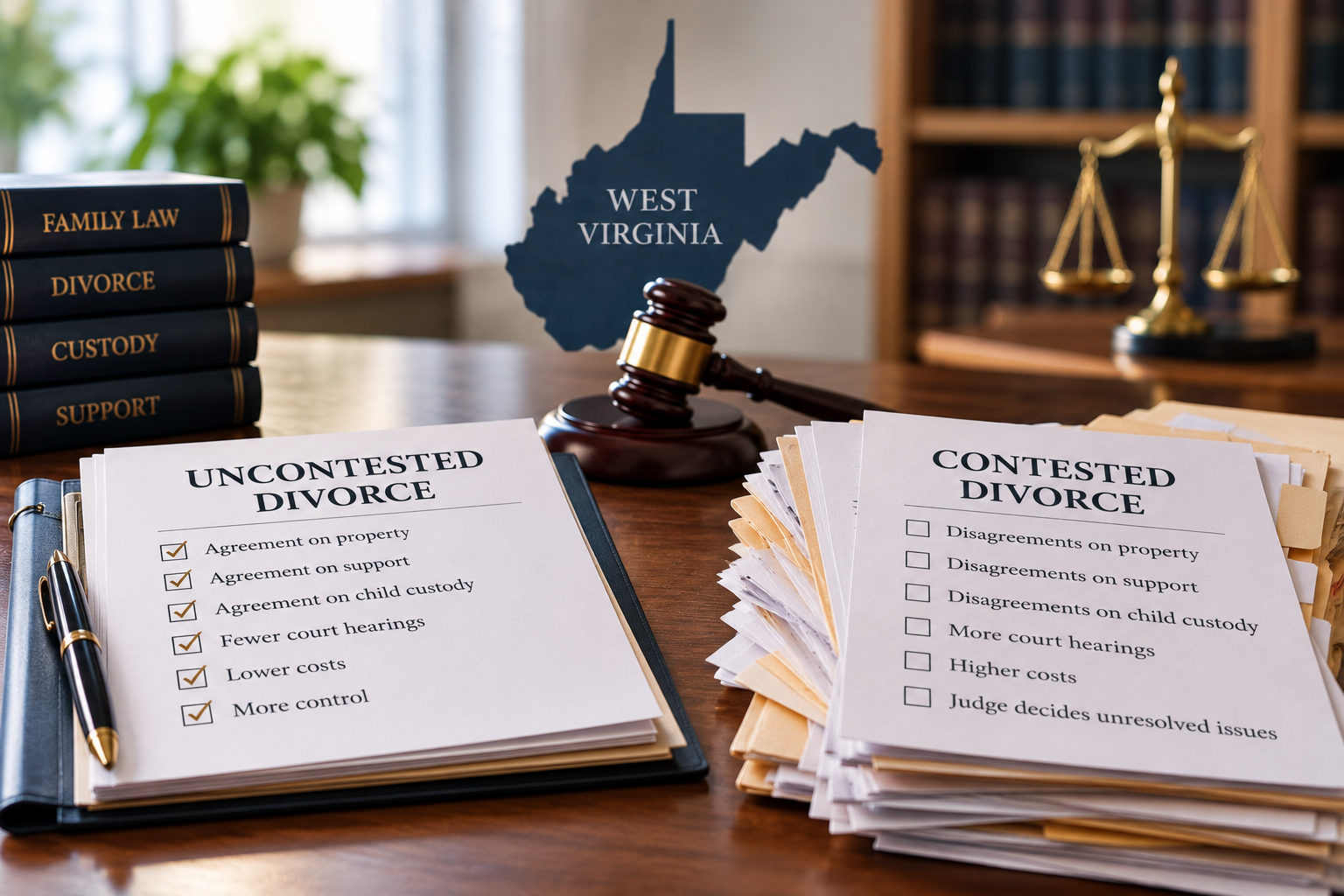
An uncontested divorce is one where both spouses agree to end the marriage and agree on every issue the court has to decide. Instead of asking a judge to settle disputes, you ask the West Virginia family court to approve the terms you've already worked out.
In practice, an agreed divorce usually means you have a complete written agreement covering:
the division of marital property, including the home, vehicles, bank accounts and retirement savings;
who pays which marital debts;
whether either spouse will pay spousal support, how much and for how long;
if you have children, a parenting plan and child support.
If even one of these is still open, the case usually isn't uncontested yet.
What Is a Contested Divorce?
A divorce is contested when the spouses can't agree on one or more of those issues, or when either spouse disputes the divorce itself. The court then has to decide the open questions based on evidence, and the case typically involves more formal steps, such as exchanging financial information, temporary hearings and, if no settlement is reached, a final hearing.
Contested doesn't have to mean hostile. Many contested cases involve reasonable people who simply see one issue differently, such as the value of a business or a holiday schedule for the children.
Uncontested vs. Contested Divorce: Side by Side
Question | Uncontested | Contested |
|---|---|---|
Do you agree on every issue? | Yes, in writing | No, at least one issue is disputed |
Who decides the terms? | You and your spouse, with court approval | The family court decides what you can't settle |
Exchange of financial information | Still required in some form | Usually more formal and detailed |
Court hearings | Usually fewer | Temporary and final hearings are common |
Time and cost | Usually lower | Usually higher, depending on what's disputed |
Control over the outcome | High | Shared with the judge |
Privacy | More details can stay out of testimony | Disputed issues are argued in court |
For general timelines and cost factors, see our guide to Divorce in West Virginia: What to Expect From Start to Finish.
What Makes a Divorce Contested?
Most contested cases come down to a few recurring disputes:
Minor children: physical and legal custody, the parenting schedule, decision-making, or a planned move.
The family home: whether to sell it, who keeps it, and how to handle the mortgage.
Valuation: what a business, real estate or a retirement account is worth, and whether an asset is marital or separate property.
Support: whether alimony is appropriate and how child support is calculated.
Trust and disclosure: concern that a spouse is hiding income or assets.
If your disagreement involves property, our article on how property is divided during a divorce in West Virginia explains the general approach to property division. For questions about the children, read Child Custody & Support in West Virginia: How Courts Really Decide.
The Middle Ground: Partly Contested Cases
Many divorces aren't fully one or the other. You may agree on the custody schedule but not on the house, or agree on everything except spousal support. In that situation, the issues you've settled can often be put in writing while the court decides only what remains. Narrowing the dispute this way can save time and keep the focus where it belongs.
Can a Contested Divorce Become Uncontested?
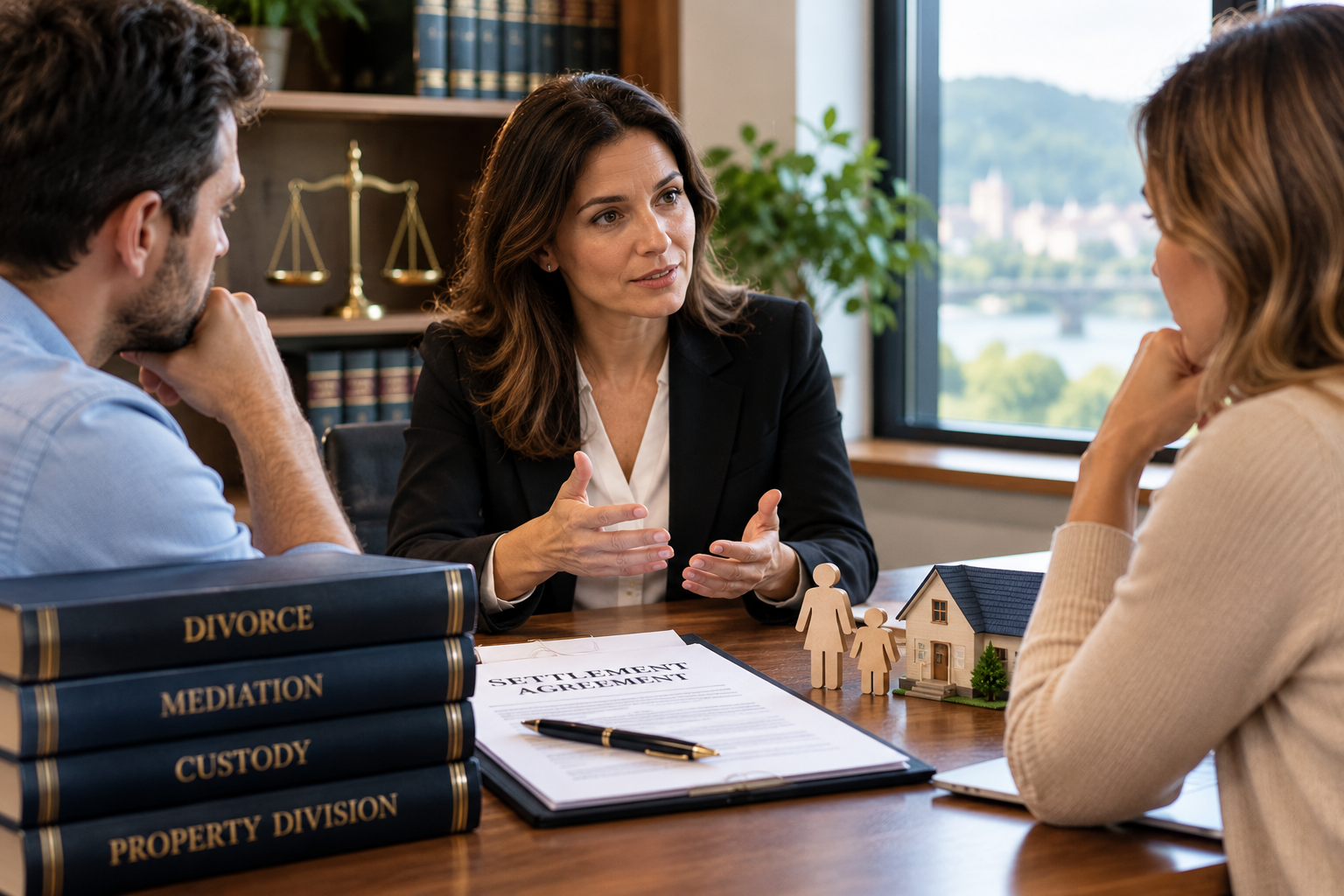
Yes. A case that starts out contested often becomes uncontested once the spouses reach a full settlement, whether through negotiation between attorneys or mediation. The reverse can happen too: an agreement can fall apart before it's final, and the case then proceeds as contested.
Mediation is one of the most common ways a contested case settles. Our firm offers mediation for domestic relations cases. To compare the two paths, see Divorce Mediation vs Court in West Virginia.
Requirements for an Uncontested Divorce in WV
Agreement alone doesn't finish the case. Before a family court will grant an uncontested divorce, a few general requirements usually apply:
Grounds: West Virginia allows a no-fault divorce based on irreconcilable differences, which is commonly used when both spouses agree.
Residency: at least one spouse must meet West Virginia's residency rules. Our start-to-finish guide covers residency in more detail.
Financial disclosure: both spouses generally must disclose income, assets and debts, even when they agree.
Children: parents generally must submit a parenting plan, and child support is calculated under the state guidelines. A parent education class may also be required.
Court approval: the court reviews the agreement, and it may decline to approve terms involving children that it finds aren't in their best interests.
No-Fault vs. Fault-Based Grounds
Every petition for divorce has to state grounds for divorce. At a general level, West Virginia recognizes two no-fault grounds: irreconcilable differences, and living separate and apart without cohabitation for at least one year under W. Va. Code § 48-5-202. Fault-based grounds also exist. Agreed divorces usually proceed on a no-fault ground, while fault claims more often appear in contested cases. Our start-to-finish guide covers grounds in more depth.
How an Uncontested Divorce Is Filed
Here is a brief overview. For the full divorce process, see Divorce in West Virginia: What to Expect From Start to Finish.
One spouse files a petition for divorce (the divorce papers) with the family court in the proper county.
The other spouse responds, often by joining in or accepting the petition.
The spouses submit their written settlement agreement and, with minor children, a parenting plan and child support worksheet.
The court reviews the paperwork and may hold a short hearing before entering the final decree.
Required forms and filing fees vary and change over time, so confirm current requirements before you file.
Is an Uncontested Divorce Always the Better Choice?
Not always. An agreed divorce is usually faster and less expensive, but only if the agreement is fair and complete. Watch for these warning signs before you sign:
you feel pressured to agree quickly;
your spouse controls the finances, and you haven't seen full statements;
retirement accounts, a business, or the home haven't been valued;
the agreement is vague about who pays which debts;
the custody arrangement doesn't address holidays, school decisions or a future move.
Once the court approves an agreement, it can be hard to change the property terms later. Spending time on the details now is usually cheaper than trying to fix them after the decree. And if you aren't sure you want to end the marriage at all, legal separation (in West Virginia, generally a separate maintenance action) may be an alternative worth discussing.
Do You Need a Lawyer for an Uncontested Divorce?
The law doesn't require you to hire a lawyer [CLIENT TO CONFIRM], and some couples handle simple uncontested cases on their own. Even so, many people choose to have an attorney draft or review the agreement, because a missing clause about retirement, taxes or the children can be costly later. In a contested case, legal representation matters even more, since the judge will decide the disputed issues based on the evidence presented.
If you're meeting with a lawyer for the first time, our guide to your first divorce consultation in Charleston explains what to bring and what to ask.
Frequently Asked Questions
How long does an uncontested divorce take in West Virginia?
It's usually faster than a contested divorce, but timing depends on the court's schedule and whether your paperwork and agreement are complete. Our start-to-finish guide gives general timelines.
What if my spouse won't sign the agreement?
Then the case generally proceeds as contested, and the court decides the issues you can't settle.
Can we use the same lawyer?
Generally, one attorney can't represent both spouses, because their interests may conflict. Either of you may hire an attorney while the other reviews the agreement with their own.
Do we have to go to court if we agree on everything?
A court still has to approve the agreement and enter the decree. Whether either spouse must attend a hearing can vary.
What does an uncontested divorce cost?
It depends on the complexity of your agreement, whether you hire an attorney, and court filing fees. No single figure fits every case, so ask an attorney for an estimate based on your situation.
What if my spouse lives in another state?
You may still be able to file in West Virginia if residency and service requirements are met, but jurisdiction over some issues, such as property or support, can be more complicated.
What forms do I need?
Typically, a petition, a response, a settlement agreement, and, if you have children, parenting and support documents, but the exact forms vary. An attorney can confirm which ones apply.
Does it matter who files first?
In an uncontested case, it usually matters little. In a contested case, ask an attorney about timing before you file.
Talk to a Charleston Divorce Attorney
Ray, Winton & Kelley has served clients since 1897, and our attorneys handle contested and uncontested divorce, separation agreements and other family law matters in Charleston and throughout West Virginia. Attorneys Mark W. Kelley and David S. Hughart concentrate their practices in domestic relations, and both have taken mediation training through the West Virginia State Bar. Learn more about our family law attorneys in Charleston, WV, and our mediation services.
Schedule a consultation: call (304) 342-1141, email RWK-Receptionist@rwk-law.com, or use our contact form.
Ray, Winton & Kelley, 109 Capitol Street Suite 700, Charleston, WV 25301. Assistance Hours: Mon – Fri 9:00am – 5:00pm.
